Overhead paging, and what zoning really means
A page that nobody can make out is not a communication system, it is a noise. Most of the difference is in the layout.
September 7, 2026 · 4 min read
Overhead paging is one of those systems people stop noticing until it stops working. It runs constantly in car dealerships and grocery stores, and it does two very different jobs at once: it carries announcements to staff, and when nobody is paging, it carries background music to everybody else.
Those two jobs pull in opposite directions, and how a system handles that tension is most of what separates one that works from one that everybody quietly hates.
Why big floors get split into zones
A zone is simply a group of speakers that can be addressed on its own. A dealership might have the showroom as one zone, the service drive as another, the parts department as a third, and the shop floor as a fourth. A store might separate the sales floor from the back rooms and the loading dock.
The reason to bother is that these areas are not the same. The shop floor has compressors, impact wrenches and a door open to the street, so it needs real volume to be heard at all. The showroom has a customer sitting across a desk from a salesperson trying to close, and a page at shop-floor volume lands in the middle of that conversation.
Without zoning you have to pick one volume for the whole building. It is either too quiet where it is noisy, or too loud where it is quiet, and usually both at once. With zoning, a call for somebody in parts goes to parts.
Clarity is not the same as volume
When a page is hard to understand, the instinct is to turn it up. That often makes it worse. In a large room with hard surfaces, a small number of loud speakers produce strong reflections, so the sound arrives at you more than once, slightly out of step with itself. Speech turns to mush, and turning it up makes a louder mush.
The usual fix is the opposite of the instinct: more speakers, spread out, each doing less. Every listener is closer to the nearest one, so the direct sound is stronger relative to the reflections, and everybody hears roughly the same level instead of being blasted under one speaker and straining two aisles over.
The music problem
Background music and paging share the same speakers, which sounds efficient and creates a small daily nuisance. Music sounds best at a level people barely register. Pages need to cut through. If both run at one setting, either the music is intrusive or the pages get lost in it.
A properly set up system handles this by ducking the music when a page comes in and restoring it afterwards, so the announcement arrives into something close to quiet. It is a small detail that makes the difference between a system staff use and one they work around by walking across the building to find somebody.
Things worth thinking about before installing one
- Which areas genuinely need to be addressed separately, and which can share. Every zone is a real division in the wiring, so it is worth deciding deliberately rather than adding them later.
- Where the ambient noise actually is. Walk the building during a busy hour, not first thing in the morning when it is empty.
- Ceiling height and surfaces. A tall shop with a metal roof behaves nothing like a carpeted office with a suspended ceiling.
- Who needs to be able to page, and from where. A single station behind one counter is a bottleneck if the person who needs it is usually somewhere else.
- Whether outdoor areas such as a service drive or a lot are included, since those need equipment suited to being outside.
It is mostly a cabling job
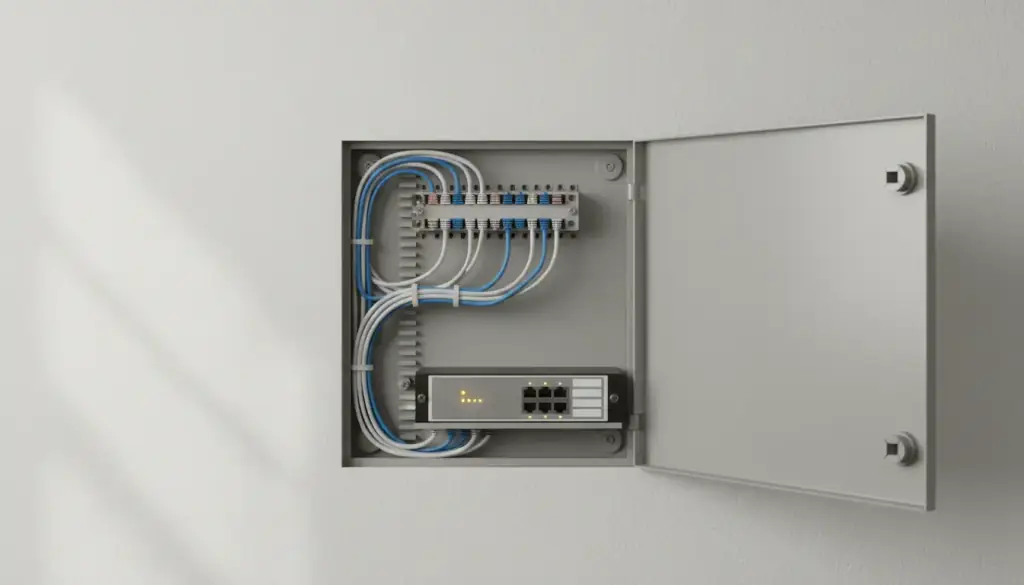
The part people underestimate is that a paging system is largely structured wiring with speakers on the end of it. Runs go out to every speaker location, back to an amplifier, and the zoning is decided by how those runs are grouped and landed. Getting the layout right is what determines whether the system can be adjusted sensibly later, or whether every change means pulling new cable.
That is also why it tends to sit with the same people who do the phone system. The paging often ties into the phones so a page can be made from a handset, and both live on the same infrastructure in the same closet.
5E Communications installs overhead paging along with phone systems and network cabling for businesses across the Texas Panhandle, and has been doing it out of Amarillo since 2006. If you have a floor where nobody can make out a page, call the shop at (806) 674-6900 and describe the building.
5E Communications, (806) 674-6900
Call (806) 674-6900More articles
Why one wired drop still beats a better router
Most people try to fix a slow room by buying a bigger router. Sometimes that works. Often the room just needed a wire.
What actually happens when an office moves to a cloud phone system
The pitch is usually about features. The part that changes your week is much simpler than that.