A television on the wall with nothing showing
Almost anybody can hang a screen. The work is deciding what goes behind it before it goes up.
September 7, 2026 · 4 min read
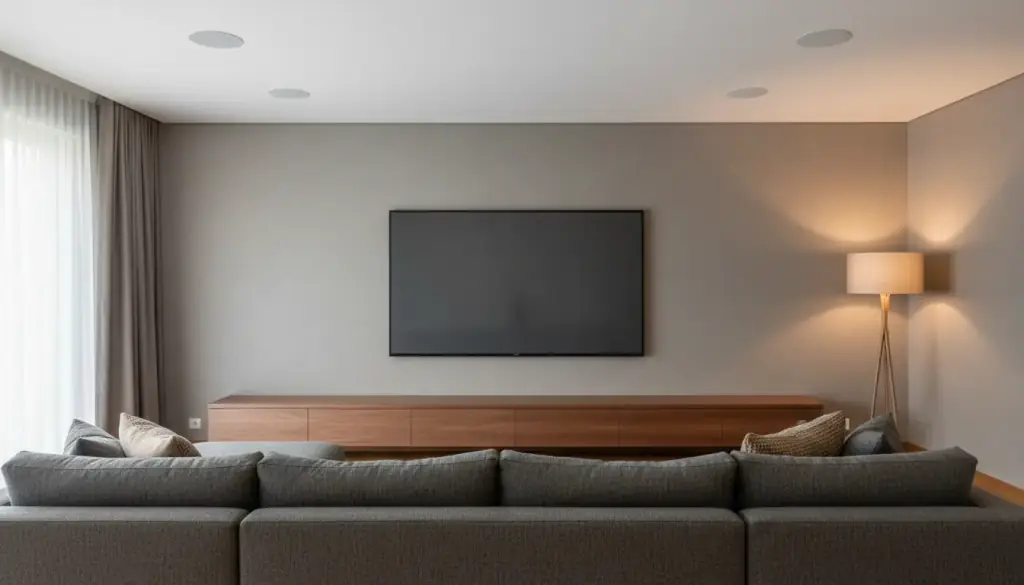
A wall-mounted television with a bundle of cables hanging down to a cabinet is one of the most common sights in a living room, and it is almost always the result of the same thing: the screen went up first, and the cabling was worked out afterwards.
Doing it the other way round is not much more work, but it has to happen in the right order.
Decide what the wall has to carry before it goes up
The question is not how to hide one cable. It is what this wall needs to carry for the next several years. A screen usually needs power, at least one video source, and increasingly a network connection so it is not depending on wireless for a sustained high bitrate. If there is any audio beyond the television's own speakers, that is more. If a source is going to live somewhere other than directly underneath, that is a run across the room rather than straight down.
It is worth running more than you currently need while the wall is open, because the cost of an extra cable during the job is small and the cost of adding one later is a second job.
Height, and the mistake nearly everybody makes
Televisions get mounted too high. It happens because people place them while standing up, or because there is a fireplace and the space above it looks like the obvious spot.
You watch sitting down. A screen roughly at seated eye level is comfortable for a couple of hours. One placed for a standing viewer means everybody spends the evening with their chin up, and people usually describe that as the room being uncomfortable without identifying why. If the only available wall really is above a fireplace, a mount that pulls out and tilts down is worth having rather than fixing the screen flat and high.
Antennas are not a period detail
It surprises people that HDTV antenna installation is still a live part of this work, but plenty of households want local channels without paying for them, and modern broadcast picture quality over the air is good. The install is not complicated, but placement and aiming matter, and it is far easier to run that cable at the same time as everything else than to add it later.
Where the sound comes from
Flat screens have very little room inside them for speakers, which is why dialogue on an otherwise excellent television can be hard to follow. Any separate audio, whether that is a soundbar or in-ceiling speakers, needs its cabling planned at the same time as the screen. In-ceiling speakers in particular are one of the tidiest results available in a finished room, and one of the most irritating things to retrofit once everything is closed up.
What a tidy install actually looks like
- Nothing visible between the screen and whatever sits below it.
- Power and low voltage handled properly and separately, which is the part people improvise on and should not.
- A network drop behind the screen rather than the television competing for the house Wi-Fi.
- Enough slack behind the mount that the screen can be pulled away from the wall to reach the connections.
- Spare capacity for the next thing, because there is always a next thing.
The connection to everything else in the house
A theater room, an office drop and a phone system look like different jobs to a customer and are the same job to an installer. Each is a run that has to leave a central point, get through the building, and land where somebody uses it. That is why the same shop tends to do all three, and why a house that has been wired properly once absorbs the next addition easily.
If the network side of the house has already been thought about, the entertainment side becomes straightforward. If it has not, the television is often the thing that finally exposes it, because streaming at a high bitrate is the most demanding sustained load in most homes.
Before you buy the mount
Sit down in the room, look at the wall, and work out where your eyes actually are. Then think about what has to reach that wall, and what might have to reach it in three years. Those two answers decide the whole job, and both are much cheaper to get right before anything is fixed to a stud.
5E Communications handles audio and video cabling, television wall mounting, HDTV antennas and home theater installation across the Texas Panhandle. If you have a wall in mind, call the shop at (806) 674-6900, Monday to Friday between nine and six.
5E Communications, (806) 674-6900
Call (806) 674-6900More articles
Why one wired drop still beats a better router
Most people try to fix a slow room by buying a bigger router. Sometimes that works. Often the room just needed a wire.
What actually happens when an office moves to a cloud phone system
The pitch is usually about features. The part that changes your week is much simpler than that.